Stabilized a fragile kiosk app with React Router and Vite while delivery continued.
mazon's Store-within-a-Store needed a dependable interactive platform on constrained BrightSign hardware after the original delivery path lost continuity. The React app had collapsed into one prop-drilled screen, so each new feature put the rest of the retail experience at risk.
I mapped the existing behavior, then built a React Router hash shell route by route. The strangler migration kept the experience live. As each route stabilized, I separated state and responsibilities, moved MQTT, and made the app smaller to render, test, support, and hand over. I set the direction in one month; the next covered recovery paths, build documentation, and team ownership.
- 01A hash-router shell and shared debug layer made every screen recoverable on kiosk hardware.
- 02Vite defines, async imports, and a custom location-asset plugin shipped only the content each store needed and failed clearly when configuration was wrong.
- 03Error boundaries, logging, and last-stable-state recovery turned non-critical failures into a manageable support path.
Made university discovery across the country navigable.
oalBound helped students and universities form teams around scholarship opportunities, putting contacts, costs, coverage, and school context in one decision surface. I joined on a tight schedule to make country-wide data useful rather than overwhelming.
I built the schools map with Leaflet, open map providers, light and dark modes, and H3 indexing. It made country-scale information navigable and opened a path to future views of recruiting patterns, student origins, and state-level insight.
- 01Leaflet map layers in light and dark mode plus H3 indexing kept university data legible at country scale.
- 02Zoom-aware hexagon aggregates combined scheduled materialization from Amazon RDS for PostgreSQL, spatial Redis caching, and direct low-density calculations.
- 03React Query cancelled stale map requests; event-driven updates refreshed changed hexagons without saturating the backend.
Explored a multi-tenant path for a useful civic app.
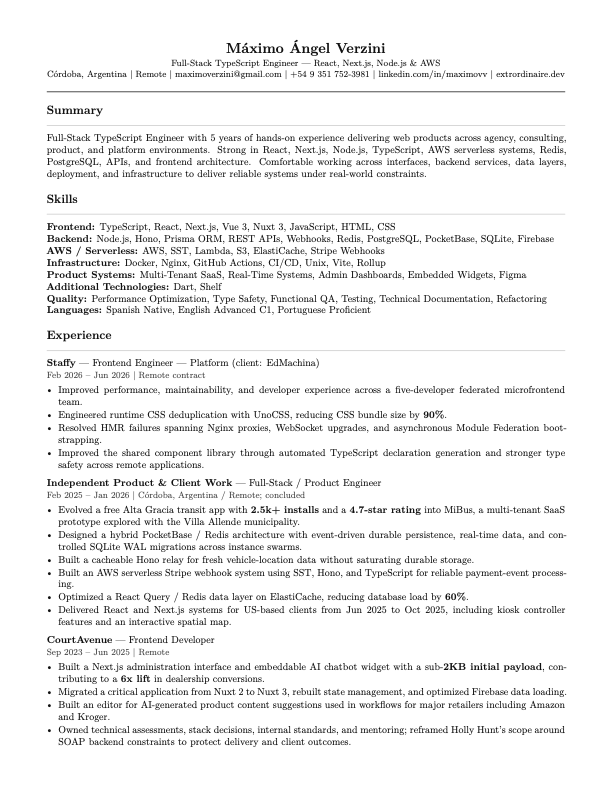
aragracia began as a free transit app for Alta Gracia and reached 2.5k+ installs with a 4.7-star rating. I joined after its early civic success, shaped the product and internal workflows, and helped evolve it into MiBus: a multi-tenant SaaS direction explored in depth with the Villa Allende municipality. It remained a prototype and did not gain commercial adoption.
I learned directly from passengers, drivers, and operators. I designed complete apps in Figma: flows, mockups, components, visual systems, and interactive prototypes. Then I engineered the tools and real-time architecture behind them.
- 01Direct conversations with passengers, drivers, operators, and the municipality grounded product decisions in operating reality.
- 02A PocketBase and Redis event architecture combined fresh real-time data with durable persistence and controlled SQLite WAL migrations across instance swarms.
- 03A cacheable Hono relay served fresh vehicle locations without saturating durable storage.
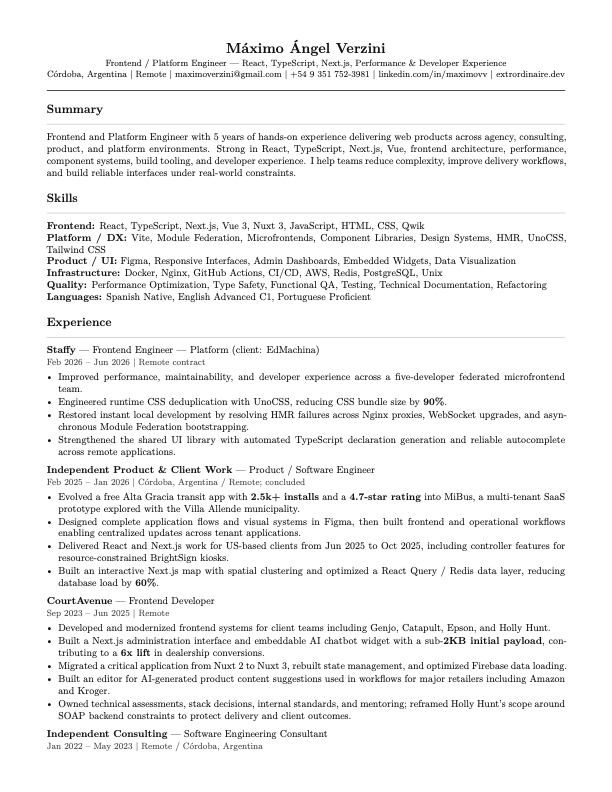
Cut 90% of CSS weight from a federated frontend platform.
dMachina's federated frontend carried overlapping Vuetify and Tailwind payloads across its microfrontends. I needed to give leadership and remote teams a migration path they could adopt without pausing product work.
I co-designed and prototyped runtime CSS deduplication with UnoCSS, giving remotes a smaller shared styling contract. In two weeks it cut CSS bundle weight by 90%; asynchronous Module Federation bootstrapping and corrected Nginx WebSocket upgrades restored dependable HMR, while generated TypeScript declarations replaced loose any with a usable contract for all five developers on the team.
- 01UnoCSS runtime deduplication replaced overlapping legacy CSS payloads and reduced bundle weight by 90% in the first two weeks.
- 02WebSocket upgrades through Nginx and asynchronous Module Federation bootstrapping restored dependable HMR across remotes.
- 03vite-plugin-dts made the shared UI library publish typed contracts instead of leaking any across applications.
Modernized client platforms without slowing the agency down.
t CourtAvenue, teams relied on my technical judgment across retail, e-commerce, and generative-AI products. I owned stack choices and assessments, helped set engineering standards, mentored teammates, and took on important client portfolios because I could turn constraints into a credible path forward.
For Genjo, a lean embeddable chatbot and Next.js admin product helped lift dealership conversions 6×. For Catapult, I migrated Nuxt 2 to 3, rebuilt state and data loading, and shipped a Grammarly-style AI editor. At Holly Hunt, I surfaced missing capabilities and SOAP backend constraints, reframed scope with the client, protected the deadline, and improved the relationship through direct, real-time collaboration.
- 01Genjo's embedded chatbot widget used deliberate code-splitting to stay small and contributed to a 6× dealership conversion increase.
- 02Catapult's Nuxt 2-to-3 migration rebuilt state and data loading while adding a Grammarly-style AI suggestion editor for retail PDPs.
- 03A requirements assessment for Holly Hunt made backend constraints and missing capabilities explicit, enabling a realistic scope and an on-time delivery.